Tremont Director Signs on to Leadership Now Project Business for Racial Equity Pledge

Our hearts are heavy with the events of the past weeks. 

As citizens, we applaud and stand in solidarity with all Americans exercising their civil liberties and risking their lives and livelihoods for a more just and inclusive nation.  We know that our democracy will never be strong until we fully acknowledge and address America’s history of racism. 

As business people, we see a great need—and opportunity—for the business community to mobilize on issues of economic, social, and racial justice in new, innovative and evidence-based ways. 

We have seen heartfelt expressions of anguish and disgust from chief executives across Wall Street and corporate America. They acknowledge the senseless loss of life we have witnessed in recent weeks, not from the Covid-19 pandemic, but from this nation’s other deadly infectious disease: racism. 

We applaud these statements, and do not doubt their sincerity. But virtuous condemnations of racism and broad commitments to diversity and inclusion rarely translate into tangible, measurable, anti-racist action. 

Real change will require determined leadership from the business community. 

To that end, the co-authors of this letter, whose members represent the highest levels of management at dozens of U.S-based companies contributing billions of dollars to the nation’s GDP, have devised a list of concrete actions that companies can take now to begin to dismantle three of the biggest levers of racist power in this country: biased policing, electoral disenfranchisement, and economic exclusion.

Policing

The roots of American policing did not evolve around the promotion of public health and safety, but the protection of business and economic interests, and enforcement of the social order

The fact that Dylan Roof, a white supremacist and mass murderer of eight black churchgoers, can be taken peacefully into police custody, while Eric Garner and George Floyd lost their lives for allegedly selling loose cigarettes and using a counterfeit $20 bill at a convenience store, speaks to vestiges of norms and culture forged during slavery and Jim Crow. It is a system that too often devalues, criminalizes, threatens and, at its worst, ends innocent black lives. 

We simply cannot allow another generation of black children to grow up in a nation where law enforcement can kill with near impunity. 

We pledge to champion and drive meaningful progress across these actions:

  • Financially support data-informed police reform. Our members are making donations to the Center for Policing Equity, The Policing Project, and the Police Use of Force Project, three organizations with superb data and evidence-based approaches to racially-just policing. 

  • Compel mayors and city legislators to make police reform a priority in cities where you have a significant presence. This public safety advocacy toolkit from the Obama Foundation offers an excellent place to get started.

  • Re-evaluate your company’s political donations. Scrutinize your company’s political donations to ensure the candidates and other political entities you support are not inadvertently (or intentionally) preventing progress on policing reform initiatives.

Civic Participation & Safe Ballot Access 

Voter suppression is another form of systemic racism. We must take a stand to ensure ballot-box access to communities of color and to protect their right to vote. 

We pledge to champion and drive meaningful progress across these actions: 

  • Donate to organizations that protect voter rights, for example the NAACP and Black Voters Matter, that work specifically within the black community. 

  • Publicly advocate for action at the state and local level, including access to early voting, vote-by-mail, and other efforts to ensure that your employees of all backgrounds can vote easily and safely, particularly amidst the ongoing Covid-19 public health crisis.    

Economic Inclusion

Racism is a blight not only on the prospects of individuals and communities, but on the American economy as a whole. And the massive job losses caused by the current pandemic have hit Black communities especially hard. The economy we rebuild post-Covid must be an inclusive one. 

We pledge to champion and drive meaningful progress across these actions: 

  • Develop anti-racist workplace initiatives and track their progress. At a minimum, every organization should commit to inclusive hiring and retention practices; living wages and pay equity; board and supplier diversity; and anti-racist training for staff, especially frontline employees. 

  • Establish talent sourcing partnerships with job training programs serving black communities. Work with established nonprofits successfully reskilling and upskilling workers in minority communities for in-demand jobs. 

  • Direct more investment capital to black entrepreneurs, black-owned small businesses, and black fund managers

These are just a few strands of a much broader and complex set of institutional challenges. A truly just and inclusive society will require innovative and equitable solutions to so much more: education, healthcare, and housing, to name a few. 

But the initiatives above are an important start. 

Signed,

The membership of the Leadership Now Project

Leadership Now Project was founded by Harvard Business School alumni in 2017. Several black executive and Leadership Now members led this effort, including Craig Robinson, Lisa Lewin, and Tamer Mokhtar, and welcome partnership and engagement in this initiative.
Tremont Director Quoted On Biden VP Search

Joe Biden turns to friend and confidante Chris Dodd to help him choose running mate

Christopher Keating

8-10 minutes


Joe Biden is on the verge of making one of the biggest decisions of his long political career, and he has turned to former Connecticut Sen. Chris Dodd to help him make the crucial choice.

Dodd is serving as co-chairman of a special task force that is vetting candidates to be Biden’s running mate. While three other co-chairs are helping in the process, none of them has the deep personal friendship and political ties that Dodd has with Biden, officials said.

Dodd has said he served in the trenches for 30 years “on a daily basis” with Biden on the Senate Foreign Relations Committee and on the Senate floor on a wide variety of issues and political battles. Dodd is now 76 years old, and Biden is 77.

They joined together in Connecticut last fall at one of the biggest fundraisers of the year for Biden’s presidential campaign at Gov. Ned Lamont’s Greenwich home, where Dodd stood side by side with Biden and pledged his support for the campaign.

“I’m going to dedicate the next 13 months of my life,” Dodd told the crowd at the time. “I don’t want to wake up on the day after the election in 2020 and think I didn’t do enough.”

While others have been raising money and plotting strategy, Dodd has spent long hours on the vice presidential vetting process, colleagues said. Dodd declined to comment for this article and is refusing all interviews in order to preserve the confidentiality of the selection, according to two close associates who have spoken to him.

But widespread media reports say national figures such as Sen. Kamala Harris of California and former National Security Advisor Susan Rice are in the running in a high-profile pick that could be announced before Aug. 1.

While the behind-the-scenes deliberations are secret, Biden tweeted on March 15 that “my running mate will be a woman.”

Former state Democratic Chairman John Droney, an attorney who has been involved in multiple campaigns, said Dodd is clearly a close confidante of Biden who is “the first among equals” on the team helping to choose the candidate in a delicate process that is often marked by political jockeying and outsized egos.

“Secrecy is very, very important,” Droney said. “The people who are potential candidates are often the ones who leak things to advance their own interests. There are some things that you can’t control, but the things you can control, you keep a pretty tight lid on it.”

He said Biden and Dodd are being careful to make sure that the candidate is best for the party and will not backfire.

“They want to avoid the Sarah Palin problem, which cost John McCain the presidency of the United States in my opinion,” Droney said of the former Alaska governor who was on the Republican presidential ticket in 2008. “That hurt him. You try to get a vice presidential candidate who doesn’t cost you anything and maybe gets you a point or two. McCain lost a point or two and then some, and Biden can’t afford to do the same thing. Period.”

Droney said he believes the best candidate is U.S. Sen. Tammy Duckworth of Illinois, who lost both legs while serving as a U.S. Army helicopter pilot in 2004 during the Iraq War.

“If you’re going to be practical about electing a president, you should pick a woman who will appeal to middle-class people who are not ideologues across the country,” he said. “She’s a war hero. She gave a lot for her country already. People respect that military service. That component is not part of the Democratic picture anymore. There are very few active Democrats who actually served in the military. ... Biden needs to get the middle class of America on his team.”

Unlike Droney, U.S. Sen. Richard Blumenthal has not publicly backing a candidate to be Biden’s running mate because he is personally friendly with three fellow U.S. senators in contention — Harris, Duckworth and Elizabeth Warren of Massachusetts. Blumenthal has spoken to Dodd about the process and was not surprised about Dodd’s reluctance to talk publicly at this point.

“Joe Biden couldn’t rely on a person of better judgment and extraordinary insight than Chris Dodd, who is a battle-tested wise man of the political process who has seen it at a lot of different levels,” Blumenthal told The Courant. “Chris Dodd’s contribution here is to offer insight on what the downsides might be with any particular candidate, as well as the advantages. There are people who are seeking to advise them, which comes with the territory. They’ve been to this rodeo before a number of times at the highest levels, so the rest of us are almost amateurs by comparison.”

The other three co-chairs in the selection process are not as prominent on the national stage as Dodd, who ran briefly for president and served as the general chairman of the Democratic National Committee during the Clinton administration. They are Los Angeles Mayor Eric Garcetti; U.S. Rep. Lisa Blunt Rochester, a Democrat from Biden’s home state of Delaware; and Cynthia Hogan, who has worked with Biden in the past and helped vet the nomination of U.S. Supreme Court Justice Sonia Sotomayor.

The biggest vice presidential vetting process in Connecticut history came in 2000, when U.S. Sen. Joe Lieberman joined the national ticket with then-Vice President Al Gore. Matthew Hennessy, a former Lieberman fundraiser, campaign adviser and staff member, said longtime Lieberman aide Sherry Brown told him that Lieberman had not been informed yet of the choice — even after it was announced by a reporter on television.

“That’s how secretive it is,” Hennessy said. “The nominee himself wasn’t told by Gore. The nominee’s not the last to know, but they’re not the first to know.”

In the current cycle, Dodd recalled his decades together in the Senate when he endorsed Biden.

Dodd recalled his decades together in the Senate with Biden when he endorsed him last fall.

“I know some have forgotten those days or were younger when they occurred, but I haven’t,” he said. “I was there. I was in the middle of it, and I can’t forget, along with others, how Joe Biden was a critical and highly valued leader in all those efforts. Joe Biden will not only win our American election of 2020 and defeat Donald Trump, he will lead an America that will make us all proud.”

The two colleagues have been helping each other for years. In December 2009, Biden attended a fundraiser for Dodd in Hartford when the senator was under attack from opponents and a month before he decided not to seek reelection. Biden praised Dodd, describing him as “the single most gifted legislator in Congress now that Teddy Kennedy’s gone.”

He called Dodd his best friend, noting that Dodd was facing mediocre poll numbers at the time amid constant attacks from Republicans as “Dump Dodd” became a common refrain in Connecticut. Dodd had played a key role as leader of the Dodd-Frank legislation on the Senate Banking Committee and in crafting the Affordable Care Act.

“Chris is getting the living hell beat out of him, the living bejesus beat out of him,” Biden said at the Hartford fundraiser. “Why? Because he’s being a leader.”


CONNECTICUT RESIDENTS IN NO RUSH AS STATE “REOPENS”

New Survey Shows Only 24% of Connecticut Residents Want Quick Reopening of State Businesses


5/20/20

CONTACT: Tremont Public Advisors, 860-986-7737

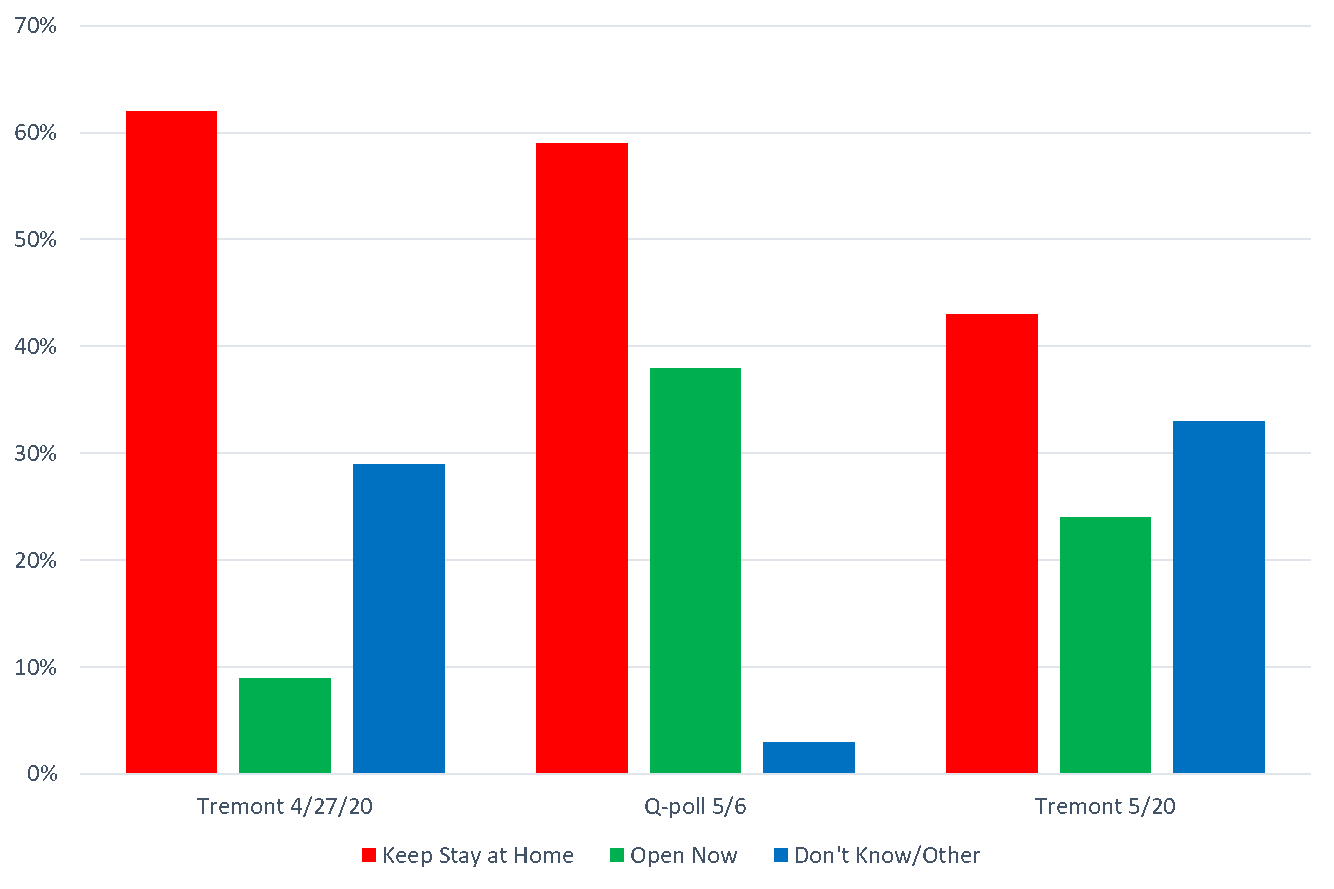
Hartford –A survey released today by the public affairs firm Tremont Public Advisors shows most Connecticut residents support the continuation of Connecticut’s “stay at home policy”, or are unsure about what next steps state leaders should take to address the COVID-19 pandemic. Even as the number of newly unemployed rises to 500,000 as a result of the pandemic, 43% of Connecticut residents support the state’s policy which has kept Connecticut residents homebound and closed hundreds of businesses and schools. An additional 33% of residents are unsure about what next steps the state should take.

The on-line survey of 704 Connecticut residents conducted between 5/18-5/20/20 asked respondents what they thought state leaders should do next in light of the hundreds of thousands of Connecticut residents filing new unemployment claims and a death toll exceeding 3,408. A plurality of residents supported maintaining Governor Lamont’s “Stay Safe, Stay Home” policy for now. 24% of respondents supported lifting the policy and opening up all businesses immediately. 33% of residents were unsure what next steps state leaders should take. These results show a 19% drop in support for the “stay at home policy” from Tremont’s 4/27 polling release and a 16% drop in support from the Q-poll’s 5/6 release.[1][2]

“As the state moves forward with “reopening” most businesses Connecticut residents have considerable reservations about the approach. There is no question that support for the “stay at home policy has declined, but those agitating for immediate reopening of all businesses remain a small percentage of the population. Governor Lamont has received high marks from most residents for his handling the COVID-19 crisis in Connecticut, providing a calm and empathetic demeanor in clear contrast to President Trump.  However, his administration is entering a tricky period of time where state policy is moving ahead of where most residents are.” stated Matt Hennessy, Managing Director of Tremont Public Advisors. “If in a few weeks residents feel that they can access testing when needed, PPE is easily obtained, deaths have significantly declined and local health districts are aggressively contact tracing, it is likely support for the state’s reopening plan will grow.”

The survey also collected a number of comments from respondents who didn’t select one of the three main survey responses. The following is a sample of the comments submitted verbatim:

“Begin partial openings of businesses. Monitor the virus.” – West Hartford, CT

“Monitor what has worked in other states. Track any rises in cases and have a quick lockdown policy if cases ramp up again”

“Open some business back im one of the people out of work since March 12 with no unemployment and i use all my saving up” -Hartford, CT

“Open up businesses, continue social distancing in the work place, continue working at home when possible, and see what the case numbers look like after taking those precautions. If the numbers show improvement, go to a phase 2 plan”

“One step at a time” – Bristol, CT

“protect the most vulnerable” - Southington, CT

Provide PPE and get as many back to work as possible. Do not open schools yet.” – Wallingford, CT

Of those supporting the “stay at home policy”, women represented the majority of the supporters with the largest age group being the 25-34 age cohort.

Of those supporting an immediate opening of businesses and lifting of the “stay at home policy”, men constituted the largest group of supporters with the largest age group being the 55-64 cohort.

Survey Results

(Responses of Connecticut residents)

Q1: If you were told that in Connecticut, COVID-19 has left 500,000 workers unemployed and at least 3,408 dead. What do You think state leaders should do next??

Keep the stay at home policy for now.        43%

Stop the stay at home policy and open all stores        24%

Don't know     30%

Other   3%


About Tremont Public Advisors, LLC: Tremont Public Advisors is a leading Public Affairs firm in Washington D.C. and Hartford, Connecticut. You can learn more about our polling here: (https://www.tremontpublicadvisors.net/news/2018/11/7/how-accurate-were-the-final-polls-in-the-race-for-ct-governor)


About Matthew Hennessy, Managing Director of Tremont Public Advisors: Recognized as one of the top political consultants in the United States by Campaigns and Elections Magazine, Matt has served as an adviser to multiple campaigns for federal, state and local office, as well as a range of high-profile corporations and organizations.

Methodology

Between 4/18/20 and 4/20/20 Tremont Public Advisors conducted a survey of 704 Connecticut residents over age 18 using an on-line survey platform. Respondents were allowed to take the survey only once and were restricted from choosing more than one answer. The answer choices were shown in a random order. The poll population consisted of Connecticut internet users viewing content on a network of web publisher sites on both mobile and desktop devices. The survey answers have a MMOE of no more than +/- 3.6%.

Gender, age and location of the survey respondents were inferred by data correlated to the I.P. address of the respondent. The survey used statistical weighting procedures to account for deviations in the survey sample from known population characteristics, which helps correct for differential survey participation and random variation in samples. The overall adult sample is weighted based on U.S. Census data using a procedure to match the demographic makeup of the target population of Connecticut internet users by gender, age and geography.

The survey was designed and paid for by Tremont Public Advisors, LLC.


[1] https://poll.qu.edu/search-releases/search-results/release-detail?ReleaseID=3660&What=&strArea=1;1;&strTime=3

[2] The Q-poll asked slightly different questions and used a different survey methodology.

Support for Connecticut “Stay At Home Order” Through 5/20/20

Support for Connecticut “Stay At Home Order” Through 5/20/20

CONNECTICUT RESIDENTS STRONGLY SUPPORT “STAY AT HOME” POLICY TO FIGHT COVID-19 PANDEMIC

4/27/20

CONTACT: Tremont Public Advisors, 860-986-7737

Hartford –A poll released today by the public affairs firm Tremont Public Advisors shows a solid majority of Connecticut residents support the state’s “stay at home” policy designed to slow the spread of COVID-19.  Even as the number of newly unemployed rises to 400,000 as a result of the pandemic, 62% of Connecticut residents support the state’s policy which has kept Connecticut residents homebound and closed hundreds of businesses and schools.

The on-line survey of 1,425 Connecticut residents conducted between 4/23-4/26/20 asked respondents what they thought state leaders should do next in light of the hundreds of thousands of Connecticut residents filing new unemployment claims and a death toll exceeding 1,400. Most residents supported maintaining Governor Lamont’s “Stay Safe, Stay Home” policy for now. Only 9% of respondents supported lifting the policy and opening up all businesses immediately. 22% of residents were unsure what next steps state leaders should take. These results are consistent with recent polling showing the majority of Americans support social distancing/stay at home policies.[1]

“Thirty days in to the Governor’s Executive Order implementing the stay at home policy and in light of protests and pressure by conservative groups to “reopen” Connecticut’s economy, most Connecticut residents continue to support the rigorous social distancing policies the state has implemented.” stated Matt Hennessy, Managing Director of Tremont Public Advisors. “Those supporting the rapid “reopening” of Connecticut’s economy, with the tactic support of President Trump, have been vocal and visible over the past couple of weeks, but their views are shared by only a small fraction of their fellow residents.” Hennessy stated further.

The survey also collected a number of comments from respondents who didn’t select one of the three main survey responses. The following is a sample of the comments submitted verbatim:

“Cancel school year, require masks in public, have tests available” – Montville, CT

“I think we should keep the stay at home in place thru May” – New Britain, CT

“lockdown state” -Newington, CT

“LISTEN TO TRUMPS POLICYS THEY ARE WORKING AND STOP WAITING TO ENFORCE THEM.” – New London, CT

“Start slowly opening up businesses while at least suggesting that they adapt their businesses to practice social distancing better.” – Newtown, CT

“Testing, testing, testing” – Wallingford, CT

“There needs to be economic assistance for the unemployed” - Orange, CT

Of those supporting the “stay at home policy”, women represented 58% of the supporters with the largest age group being the 55-64 age group (21%)

Of those supporting an immediate opening of businesses and lifting of the “stay at home policy”, men constituted 61% of supporters with the largest age group being 65 and over (24%).

Survey Results

(Responses of Connecticut residents)

Q1: In Connecticut, COVID-19 has left 360,000 workers unemployed and at least 1432 dead. What do you think state leaders should do next?

Keep the stay at home policy for now.        62%

Stop the stay at home policy and open all stores        9%

Don't know     22%

Other   7%


About Tremont Public Advisors, LLC: Tremont Public Advisors is a leading Public Affairs firm in Washington D.C. and Hartford, Connecticut. You can learn more about our polling here: (https://www.tremontpublicadvisors.net/news/2018/11/7/how-accurate-were-the-final-polls-in-the-race-for-ct-governor)


About Matthew Hennessy, Managing Director of Tremont Public Advisors: Recognized as one of the top political consultants in the United States by Campaigns and Elections Magazine, Matt has served as an adviser to multiple campaigns for federal, state and local office, as well as a range of high-profile corporations and organizations.

Methodology

Between 4/23/20 and 4/26/20 Tremont Public Advisors conducted a survey of 1,425 Connecticut residents over age 18 using an on-line survey platform. Respondents were allowed to take the survey only once and were restricted from choosing more than one answer. The answer choices were shown in a random order. The poll population consisted of Connecticut internet users viewing content on a network of web publisher sites on both mobile and desktop devices. The survey answers have a MMOE of no more than +/- 2.5%.

Gender, age and location of the survey respondents were inferred by data correlated to the I.P. address of the respondent. The survey used statistical weighting procedures to account for deviations in the survey sample from known population characteristics, which helps correct for differential survey participation and random variation in samples. The overall adult sample is weighted based on U.S. Census data using a procedure to match the demographic makeup of the target population of Connecticut internet users by gender, age and geography.

The survey was designed and paid for by Tremont Public Advisors, LLC.


[1] https://abcnews.go.com/Politics/large-majorities-americans-back-coronavirus-restrictions-slower-return/story?id=70291873

Tremont Director Quoted in Congressional Quarterly on Iowa Caucuses

Caucus States Dwindle as Turnout Stays Low Iowa may become the last holdout.

More than 300,000 Minnesotans turned out to caucus for Republican and Democratic presidential candidates in 2016. The turnout was large enough to create hour long lines in some precincts and shortages of paper ballots in others.1

But all those caucus-goers still represented only 8 percent of the registered voters in the state — a turnout rate that would be considered anemic in any primary election. That is one big reason why Minnesota, along with most other states, is switching from caucuses to primaries this year to choose its national party convention delegates.

In 2016, 14 states held Democratic caucuses. This year, only four states will — Iowa, Nevada, North Dakota and Wyoming. The Democratic National Committee (DNC) has adopted new rules that encourage state parties to find ways of motivating more people to participate in the nominating process. Whatever the virtues of caucuses, they tend to limit participation.

With so few caucus states left, some political observers wonder whether the format will die out altogether. “Good riddance, they ought to,” says Republican consultant Whit Ayres. “Caucuses reduce the number of people [participating] and make it even less likely that the ultimate winner will actually reflect the views of most people in the party.”

Caucuses involve more work, or at least more time, on the part of participants than simply showing up at a polling precinct to vote in a primary. Rather than being able to vote anytime during a 12- or 14-hour window, caucus participants must gather at a particular time — say, at 7 p.m. on a Tuesday. The event might drag on for hours. There are also fewer locations available for caucuses than for normal voting. “If we're all for participation, these are clearly low-participation events,” says Christopher Larimer, a political scientist at the University of Northern Iowa in Cedar Falls.

Iowa's caucuses first achieved national prominence when a then-obscure former Georgia governor, Jimmy Carter, used them as a springboard to the White House in 1976. Illinois Sen. Barack Obama's Iowa victory was key to his ability to upset early Democratic frontrunner Hillary Clinton in 2008. Ever since Carter, the caucuses have kicked off the presidential nominating season and lured candidates into practically taking up residence in the state in the runup to the event, which is scheduled for Feb. 3 this year.

Yet even in Iowa, participation is limited. Since 1988, less than 25 percent of registered voters have caucused. Their numbers ticked up in 2008 and may increase again this year, but likely will not exceed a third of voters.2

At Republican caucuses in Iowa, campaign surrogates make speeches in favor of their favored candidates. Participants are handed a piece of paper and write down their choice, more or less like voting.

Things are more complicated on the Democratic side. There are still speeches, but those attending are asked to express their preference by standing under a sign with the name of the candidate they favor. That makes voting a public act, with everyone able to see whom their neighbors prefer. If any candidate's support falls short of 15 percent of those gathered in a schoolroom, gymnasium or other venue, backers of that contender are asked to switch, or realign. “Once you have to realign, sometimes people leave,” Larimer says. “It's a long process on the Democratic side.”

Some observers believe the participatory nature of caucuses, with their speeches and debate, leads to a more informed process than secret ballots cast individually. In addition, fans of caucuses note they are run by the parties, rather than the states, and are used as party-building exercises.

“You find the people willing to come out for a couple of hours and do some work,” says Art Sanders, a political scientist at Drake University in Des Moines, Iowa. “Presidential preference is not the only thing they do at the caucuses. They also put people into positions in the party.”

But critics say that caucuses dampen turnout and sometimes reward more-ideological candidates whose supporters are deeply engaged.

“I have never been a fan of caucuses,” says Democratic consultant Matthew Hennessy. “They're great to witness in person, and you do get a sense of civic engagement when you're there, like having a town meeting to decide who the president's going to be. But as a system, they're very exclusionary.”

And they are not always accurate. In the past, Iowa precinct chairs have reported not the raw numbers of supporters for each candidate, but the number of delegates awarded to each, according to a formula. In 2016, Clinton and Vermont Sen. Bernie Sanders were essentially tied on the Democratic side, leading Sanders to call for a recount of the vote totals. But that was not possible, because state party officials had only counted delegates and had not kept track of raw vote totals.3

There have been other problems with caucus tallies. In 2012, results from more than 100 Iowa GOP caucuses were counted incorrectly. Former Massachusetts Gov. Mitt Romney was declared the winner on caucus night, by a grand total of eight votes. A recount found former Sen. Rick Santorum of Pennsylvania had won, by 34 votes, leading the state party chair to step down.4

All forms of vote-counting have flaws, but caucuses lack the standards common among state-run elections, such as voting machine printouts or checks to make sure precinct, county and state totals match. In 2012, vote counting in the Nevada GOP caucuses stretched over days, leading to accusations of fraud, while Romney was declared the winner in Maine before all counties had completed their caucuses.

For 2020, the DNC is requiring that the few state parties holding caucuses figure out ways of holding a proper recount. In Iowa, Democrats will release both the raw vote totals and delegate counts, making it possible that two candidates will each be able to claim victory. The national party encouraged state parties to devise methods for absentee participation, but in August it blocked plans in both Iowa and Nevada for online voting due to security concerns.5

The mere fact that Iowa holds caucuses is what allows it to vote ahead of New Hampshire, where state law requires that its primary be the first in the nation. The caucus system may survive in Iowa, but it is clearly dwindling around the country. “Iowa might be able to keep the tradition,” says University of San Diego political scientist Casey B.K. Dominguez, “but everywhere else, they're probably doomed.”

— Alan Greenblatt

http://library.cqpress.com/cqresearcher/document.php?id=cqresrre2020013120#

STATEMENT OF TREMONT PUBLIC ADVISORS, LLC CONCERNING THE CONNECTICUT SUPREME COURT RULING IN TREMONT PUBLIC ADVISORS, LLC v. CONNECTICUT RESOURCES RECOVERY AUTHORITY (SC 20119

Contact: Tremont Public Advisors 860-986-7737

Hartford – Tremont Public Advisors LLC released the following statement today concerning the Connecticut Supreme Court ruling in its anti-trust case against quasi-public state agency the Materials Innovation Recycling Authority (MIRA, formerly known as CRRA):


“For at least fifteen years since its decision in Cheryl Terry Enterprises, Ltd. v. Hartford (SC 17067)[i] the Supreme Court has allowed unsuccessful bidders to challenge the award of a public contract where fraud, corruption or acts undermining the objective and integrity of the bidding process existed[ii] using the Connecticut Anti-Trust Act. Yesterday’s ruling overturns this precedent and leaves bidders who obtain evidence of corruption in the public bidding process no effective recourse in the courts.


Though we appreciate the Supreme Court’s recognition that we had gathered ample evidence of impropriety in MIRA’s bidding process, we were stunned by the Court’s adoption of the position that no amount of corruption and illegality in the public bidding process could trigger an anti-trust violation under Connecticut law, even if that corruption reduced the number firms willing to reply to public bids. The Court stated in part:


Although the bribes may have been illegal and unfair methods of competition, their illegality and unfairness[do] not support an inference that the bribes restrained competition. On the contrary, bribery could have been consistent with intense competition among the suppliers—some of which resorted to illegal measures to gain an advantage……


We see little to distinguish an agreement to provide illegal services in exchange for the award of a public contract from an agreement to give a bribe in exchange for a public contract. We conclude, therefore, that an antitrust injury cannot be inferred from the plaintiff’s allegation in the present case that the defendant awarded the liaison services contract to Brown Rudnick because that firm was willing to provide statutorily prohibited lobbying services to the defendant…..


[A]n allegation that a public entity has awarded a contract to a preselected bidder for corrupt reasons and in violation of a competitive bidding statute does not give rise to an antitrust injury. To the extent that our decision in Cheryl Terry Enterprises, Ltd., is inconsistent with this conclusion, it is overruled…


Accordingly, even if we were to assume in the present case that potential bidders chose not to submit bids for the liaison services contract because they were aware that the defendant would award the contract only if the bidder would agree to provide illegal lobbying services, and the potential bidders did not want or were unable to provide such services, the defendant’s conduct did not prevent them from competing..’[iii]


Yesterday’s ruling has considerable policy implications for those concerned about the integrity of public bidding in Connecticut especially in cases involving municipalities and quasi-public agencies. The Governor and General Assembly should carefully review the implications of this ruling upending fifteen years of precedent.


We want to thank our legal team headed by Michael Harrington of Ford Harrison LLP who led our prior success at the Connecticut Supreme Court forcing MIRA to turn over hundreds of emails with lobbyists illegally withheld in violation of the Freedom of Information Act[iv]. We will be reviewing the decision carefully and determine what our next steps will be.”


[i] https://law.justia.com/cases/connecticut/supreme-court/2004/270cr138.html


[ii] https://caselaw.findlaw.com/ct-supreme-court/1594236.html


[iii][iii] https://www.jud.ct.gov/external/supapp/Cases/AROcr/CR333/333CR62.pdf


[iv][iv] https://www.jud.ct.gov/external/supapp/Cases/AROcr/CR323/323CR106.pdf


Polling Showing Lamont Support Softening

Hartford – The release of three recent surveys by Morning Consult and Tremont Public Advisors show that after winning the Connecticut Governor’s race in 2018 with 49.4% of the vote, Governor Lamont’s job approval rating over the first four months of his term continues to lag with Connecticut residents and voters. The polls varied in timing and methodology but were consistent in key areas:

  • A steady group of about 40% +/- of Connecticut residents disapprove of the job Governor Lamont is doing as Governor. (46.2% voted for Lamont’s Republican opponent in 2018)

  • Lamont’s voters seem to be moving from approval to undecided (not disapproval). All three polls showed double digit deficits below 50% approval and undecideds ranging from 29%-42%.

A Q-poll released 3/9/11 showed then Governor Malloy with an approval rating of 35% vs. a disapproval rating of 40%.

“Winning the election with less than half the vote presents any Governor with a hurdle to overcome in gaining the approval of half of Connecticut residents. When you add in how politicized the toll debate has become and the administration’s various proposals for cost reductions to bring the budget into balance, there are a number of Lamont’s supporters who have moved into the undecided column” stated Matthew Hennessy Managing Director of Tremont Public Advisors.

*The Tremont surveys differed from the Morning Consult survey in timing, methodology, weighting of demographics and number of questions asked.

*The Tremont surveys differed from the Morning Consult survey in timing, methodology, weighting of demographics and number of questions asked.

Between 4/18/19 and 4/20/19 Tremont Public Advisors conducted a survey of 1,333 self-identified Connecticut voters using an on-line survey platform. Respondents were allowed to take the survey only once and were restricted from choosing more than one answer. The answer choices were shown in a random order. The poll population consisted of Connecticut internet users viewing content on a network of web publisher sites on both mobile and desktop devices. The survey answers have a MMOE of no more than +/- 2.5%.

Gender, age and location of the survey respondents were inferred by data correlated to the I.P. address of the respondent. The survey used statistical weighting procedures to account for deviations in the survey sample from known population characteristics, which helps correct for differential survey participation and random variation in samples. The overall adult sample is weighted based on U.S. Census data using a procedure to match the demographic makeup of the target population of Connecticut internet users by gender, age and geography.

The survey was designed and paid for by Tremont Public Advisors, LLC.

Tremont Poll Shows Connecticut Taking A "Wait and See" Approach to Lamont

Connecticut Taking A “Wait and See” Approach to Lamont

2/25/19

CONTACT: Tremont Public Advisors, 860-986-7737


Hartford – In the wake of a state budget just released by Governor Ned Lamont designed to address structural issues with state government finances, a survey of Connecticut residents shows many are taking a “wait and see” approach to the Lamont Administration.

Tremont Public Advisors conducted an on-line survey of 1,507 Connecticut residents between February 22 and February 25, 2019 testing Governor Lamont’s favorability. The survey showed 33% of residents hadn’t developed an opinion on Governor Lamont, 23% had a favorable opinion and 44% had an unfavorable opinion.

“The good news for Governor Lamont is that most residents have either a favorable opinion of him or are withholding judgement until they learn more about his agenda. Coming off last November’s close race for Governor, Lamont doesn’t have excess political capital to spend when he is making tough choices during the budget process. However, it looks like most residents are giving Lamont the benefit of the doubt to deal with state government’s difficult fiscal situation.” stated Matt Hennessy the Managing Director of Tremont Public Advisors.

In a similar survey conduct by Quinnipiac University in March of 2011 testing then Governor Malloy’s job approval after announcing his first budget, 25% of the respondents had no opinion, 35% approved and 40% disapproved.

Survey Results

Q1: As a Connecticut resident, do you have a favorable or unfavorable opinion of Governor Ned Lamont?

Unfavorable    44%

DK/Other        33%

Favorable        23%


About Tremont Public Advisors, LLC: Tremont Public Advisors is a leading Public Affairs and Federal Lobbying firm in Washington D.C. and Hartford, Connecticut.


Methodology

Between 2/22/19 and 2/25/19 Tremont Public Advisors conducted a survey of 1,507 Connecticut residents over age 18 using an on-line survey platform. Respondents were allowed to take the survey only once and were restricted from choosing more than one answer. The answer choices were shown in a random order. The poll population consisted of Connecticut internet users viewing content on a network of web publisher sites on both mobile and desktop devices. The survey answers have a MMOE of no more than +/- 2.5%.

Gender, age and location of the survey respondents were inferred by data correlated to the I.P. address of the respondent. The survey used statistical weighting procedures to account for deviations in the survey sample from known population characteristics, which helps correct for differential survey participation and random variation in samples. The overall adult sample is weighted based on U.S. Census data using a procedure to match the demographic makeup of the target population of Connecticut internet users by gender, age and geography.

The survey was designed and paid for by Tremont Public Advisors, LLC.


Tremont Director On Opposition Research with Governing Magazine

The Growing Need for Opposition Research -- on Yourself -- in Today's Political World

BY: Alan Greenblatt | February 15, 2018

GOVERNING

The past is never dead. For all the warnings millennials have received about making sure their social media accounts are kept clean so they won't come back to haunt them later in their careers, lately it's been baby boomers and Gen Xers tripped up by analog documents from the past.

The series of recent scandals in Virginia was kicked off by the emergence of a 35-year-old yearbook page from Democratic Gov. Ralph Northam's medical school days. Back in September, members of the U.S. Senate Judiciary Committee grilled then-Supreme Court nominee Brett Kavanaugh about entries in his high school yearbook and the calendar he kept as a student.

Now reporters all over the country are scouring old yearbooks, looking for more examples of racist or otherwise disturbing images or language from the deep past of politicians. Last week, the Virginian-Pilot reported that Virginia Senate Majority Leader Tommy Norment served as managing editor for a Virginia Military Institute yearbook edition that was filled with racial slurs and blackface photos. 

All of this suggests that opposition research -- as well as self-research, which refers to candidates hiring investigators to look into their own closets -- will be a growing field in the years ahead.

"With these stories, any credible candidate is immediately going to understand the importance of self-research and not make that an issue," says Democratic strategist Tracy Sefl. "Anything that can be shared, discovered or commented upon needs to be uncovered, preferably by one's own team."

In a partisan age, long-ago offenses -- whether serious or slight -- are likely to be seized upon by political enemies and media, says David Carney, a Republican consultant.

"Social media itself is so easily offended by everything, we're in a gotcha kind of mode," he says. "No one has any interest in forgiving or forgetting."

The things that might be forgiven change over time. Not that long ago, evidence of past marijuana use would be disqualifying for a candidate. But this week, the Twitter universe was debating Democratic presidential candidate Kamala Harris' claim that she smoked pot in college, implying she was trying to inflate her street cred.

By contrast, what Northam has found -- along with so many lawmakers brought down by #metoo revelations about sexual harassment -- is that there is now less tolerance for offenses regarding race and gender than there was in the past.

Back when politics was more strictly an old boys' club, many offenses were often winked at rather than frowned upon, says Matthew Hennessy, a Democratic political consultant. Not anymore.

"People ask different questions when it's not just older white males running the show," Hennessy says. "When you have more African-Americans and women [in power], you're going to answer for it. People are putting it on the table that these behaviors in the past are relevant to how we talk about these issues in the present."


Why Candidates Should Do Opposition Research on Themselves

Opposition research -- digging up dirt on one's opponents in hopes of embarrassing them during the campaign -- is a time-honored tradition in politics. For that reason, it's important for candidates to look into their own pasts so their campaigns aren't caught off-guard when revelations turn up.

Still, politicians are often reluctant to spend money to hire investigators to look at themselves. They often believe they have a good enough memory for anything that might look bad, and they're reluctant to spend money on something that's potentially onerous and upsetting to go through.

But professional opposition researchers say that self-research is essential.

"It's a very cost-effective investment for a candidate," Sefl says. "They may balk at the initial cost, but it's cheaper than lawyers and certainly cheaper than television commercials featuring your yearbook."

Sometimes candidates don't have a strong enough sense themselves of what will play badly for them. Morals and opinions change, so things they didn't regard as a problem at the time could still come back to haunt them. 

"We've got to research you with the same eye that we're researching your opponent," says Michael Rejebian, a Democratic opposition researcher. "You're not going to like, most times, what I find, but at the end of the day it helps you."

Part of the damage to Northam's reputation derived from the fact that he and his team weren't ready to respond to the yearbook revelation. At first, he apologized for appearing in a photo that showed someone in blackface and someone else in a Ku Klux Klan costume. The next day, he claimed he wasn't in the photo but admitted to appearing in blackface on another occasion.

"Even if you know about something, but no one else in the campaign knows, this stuff comes up and then you've got to have a response in 15 minutes," Rejebian says. "Having the information allows you the time to craft a truthful, legitimate, thoughtful response."


Knowing Where to Look for Skeletons in the Closet

Rejebian and his partner Alan Huffman wrote a book about opposition research (known colloquially as "oppo") called We're With Nobody

Too often, Huffman says, contemporary campaigns rely on easily obtainable information drawn from internet searches or their own video tracking of the opposing candidate. Such "easy catches" can make for quick media hits but don't offer the depth of hiring a pro to spend a couple of weeks nosing around. 

"I still do the full meal deal when it comes to oppo, but that's not always the case," Huffman says. "Many campaigns rely on a more superficial approach to analyzing a candidate's fitness to serve, which would not likely encompass details a source could lead you to, and which may be documented in the musty shelves of a library."

An experienced researcher will know where to look. The story of U.S. Sen. Larry Craig being arrested at the Minneapolis airport for lewd conduct back in 2007 didn't break until a couple of months after the arrest. Someone figured out that since there were no direct flights between Washington, D.C., and Craig's home state of Idaho, it was worth checking the arrest records around the airport where he was most likely to change planes. 

"That's what it really comes down to: Do you have the money and do you have someone who's experienced enough to know where to look?" says Larry Zilliox, a retired opposition researcher.


Due Diligence and the Thomas Eagleton Question

In an earlier era, due diligence was essentially a foreign concept.

When Democrat George McGovern chose Thomas Eagleton as his running mate in the 1972 presidential race, vice presidential nominees were still a last-minute selection at conventions. McGovern offered Eagleton the position following a two-minute phone conversation.

It turned out that Eagleton had undergone electroshock treatments for depression years earlier. Eighteen days later, he was dropped from the ticket. Later, when asked why he hadn't mentioned the treatment, Eagleton said no one had asked him about it.

"We went over names casually, didn't do any background checking," McGovern campaign manager Gary Hart -- later a presidential candidate himself -- told NPR in 2012. "It wasn't mandated in those days as it is now. Certainly after '72 it came to be mandated. But the people trusted other people's word."

These days, vice presidential candidates undergo thorough vetting. What about candidates for less visible posts? 

Hennessy, the Democratic consultant, says it would be a mistake for anyone running for Congress, statewide office or mayor not to undergo self-vetting. Sefl, the strategist, argues that even candidates for state legislature or lower-profile offices should go through the process. Their races might not draw much attention but any juicy disclosure very well might.

"No matter how old or buried something may be, all it takes is one mention of it online to ignite into a bigger story," Sefl says.

Every serious campaign should do serious research on itself, to be prepared for anything that could possibly come up, says Carney, the GOP consultant.

"I wouldn't work for a candidate who says, 'Oh, no, I'm perfect,'" he says. "You know there are huge landmines down the road."


This article was printed from: http://www.governing.com/topics/politics/gov-ralph-northam-importance-opposition-research.html

How Accurate Were the Final Polls in the Race for CT Governor?

With the polls closed, how did the final public polls do?

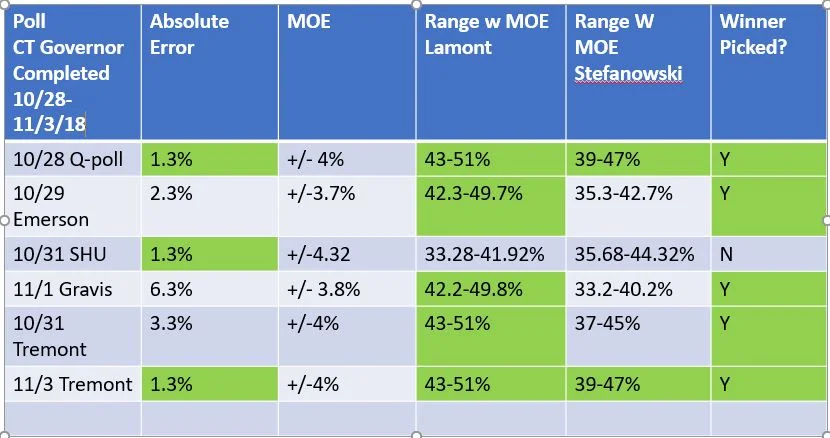
With the race for Governor of Connecticut complete and Ned Lamont confirmed as the winner (685,453) with 49.1% of the vote over Bob Stefanowski (648,086) 46.4%[1] it is a good time to take a look back at the public polling of the race and see where they got it right. Between 10/28 -11/1/18, Quinnipiac University, Hearst/Sacred Heart University, Emerson College and Gravis Marketing all completed polling on citizen preferences in the Connecticut Governor’s race which they then shared with the public.

Tremont Public Advisors concluded two related surveys on 10/31 and 11/3/18 asking Connecticut residents which candidate for governor most “shared their values”.

The polls were conducted in a variety of manners with sample sizes ranging from 500-805 verified respondents with margins of error from 3.7-4.3%. How did they do?

Absolute error on the projected vote margin (or “absolute error”), is computed as the absolute value of the margin in the poll minus the same margin in the certified vote. Quinnipiac and Hearst/SHU polls had the smallest absolute error in the group with 1.3%. Their results most closely tracked the final difference between Lamont and Stefanowski (2.7%) in the final vote tally.

Quinnipiac, Emerson and Gravis correctly identified Ned Lamont as the likely winner of the Governor’s race.

Lamont’s final share of the vote fell within the range (including MOE) identified by Emerson and Gravis. Quinnipiac correctly identified both Lamont and Stefanowki’s share of the final vote within the MOE of its survey.

The final 11/3/18 Tremont survey asking Connecticut residents which candidate most “shared their values” had results that correlated closely with each candidates’ final share of the vote within the MOE with an absolute error of 1.3% (using “shared values” as a proxy for electoral support).

Though Quinnipiac concluded its polling eight days before Election Day, its final survey best reflected the election outcome. The other surveys, in all but one case, correctly identified the winner, yet understated the share of the vote that eventually went to Stefanowski possibly missing the late leakage of Republican voters from independent candidate Oz Griebel to Stefanowski.


[1] Results from CT Secretary of State’s website and the New Haven Independent’s tally of the vote in New Haven.

The final polls by Tremont Public Advisors and Q-poll were the most accurate public polls

The final polls by Tremont Public Advisors and Q-poll were the most accurate public polls